Perry County Officials Share Flood Plain Information
NEW LEXINGTON, OH – Perry County Officials are sharing information for home and property owners who may be in flood plains.
Perry County Commissioner, Ben Carpenter, has spent most of his career in Perry County, 30 years of which he served as the Administrator of the Soil and Water Office and 25 as the County’s Flood Plain Manager.
He says thought it would be a good time to share some information on what a flood plain is and how the levee we reported on last week is still doing its job 66 years later.
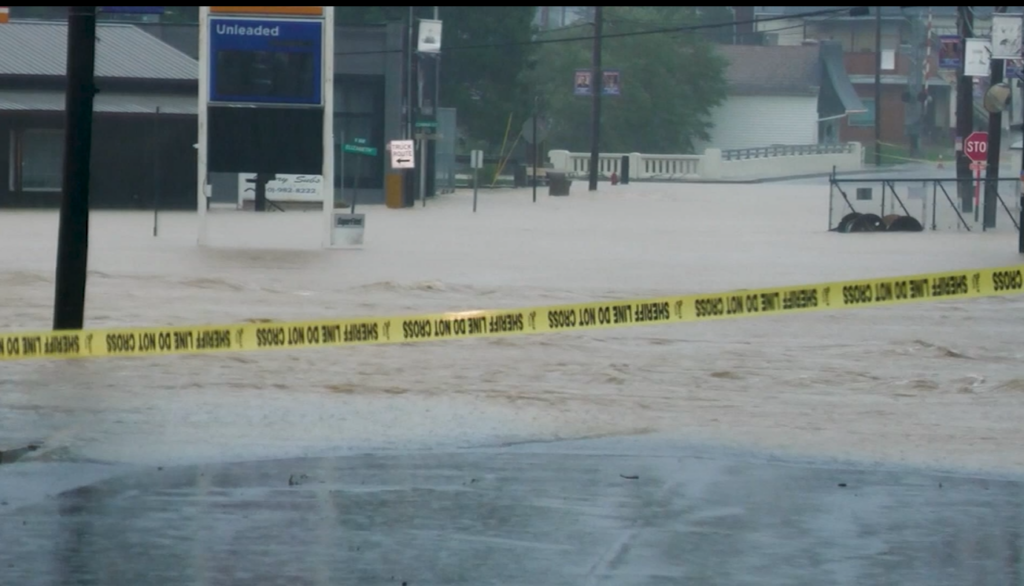
“Land that’s in a flood plain, floods. It’s going to rain and flood waters rise.” Carpenter said. “In 1950, there were some major storms, flooded Roseville, and wiped out Roseville. As a result of that, that levee that you see and reported on along Roseville was built in 1960 by the Army Corps of Engineers and it protected the Village of Roseville. This was the first event that really challenged that levee but it did its job, it held, and it protected them.”
Carpenter says without the levee, some parts of the county could’ve faced up to 5 feet of water instead of 2.
He says the common misconception with flood plains is people think they’re created due to global warming and climate changes but that’s not the case.
“This glass is going to be our flood plain, not the river or the creek, but the flood plain. So let’s say this flood event is up to this black line and the trouble or problem with flood plains is every year, these marbles are going to represent buildings and encroachment and development in the flood plain. So as buildings get built, in the flood plain, year after year, more and more houses get built, barns get built, soil gets added, more roads are built or developed, and what happens is that the capacity of the flood plain is diminished. So the event that we had recently brought that flood level up to that black line and it could build for another 10 to 20 years, you can see the same amount of water, now we have a flood event elevation that’s increased.”
Those who need assistance in Perry County are advised to contact the EMA’s Office, (740)-342-1141, or Perry County Transit, (740)-342-2810, if you are in need of a ride.