ZFD holds hazmat training drill at Secrest Auditorium
ZANESVILLE, Ohio- You may have noticed increased law enforcement activity around Secrest Auditorium today and if you wondered what was going on, you’re not alone.
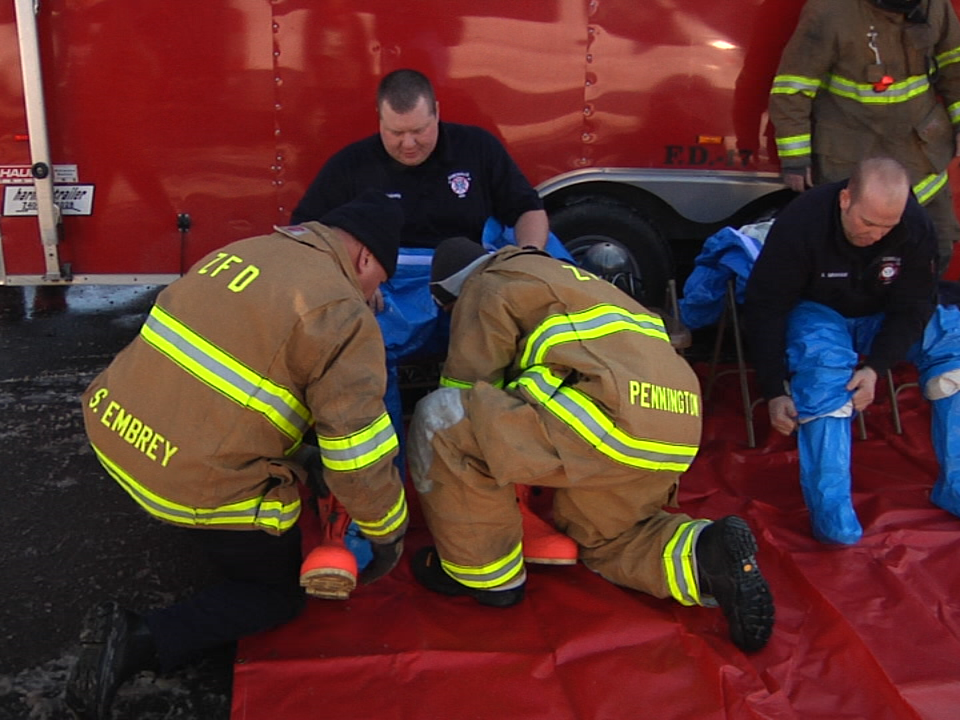
Roads were blocked off, ambulances and fire trucks were everywhere, the parking lot of Secrest was filled with military trucks and equipment. While it looked like the scene of some huge disaster, it was really just the Zanesville Fire Department executing a hazmat training drill. The department does this training every three years to help prepare for a real emergency. They go through a simulated drill as if the situation is real.
“The scenario today that we’re using is an unknown white powder in Secrest Auditorium. So we have taken upon to call in another team of experts,” said Zanesville Fire Department Assistant Fire Chief Doug Hobson.
The drill started off with a disgruntled employee driving a van into the side of the auditorium. When police go to arrest him they find him covered in battery acid. The Zanesville Police Department plays their role and detains the suspect. The suspect is then deconned before being transported to Genesis Hospital for treatment. After the suspect is taken away the fire department goes inside the building to evaluate the structural damage where they find more than they bargained for.
“While making entry to Secrest Auditorium we had 3..excuse me 2 patients down. So those patients had to be brought out. They also have to be deconned, medically evaluated, and taken to Genesis for further treatment.”
ZFD had some assistance with the drill. The 52nd WMD Civil Support Team out of Columbus came to train with the department. In the event of a real emergency, the Ohio National Guard unit could be called in to help out so they try to get some real life training in with one another.
“This really helps us ensure that the relationships are built ahead of time so should there unfortunately be a need that we have to work together we’ve already established those relationships,” said Lieutenant Rick Glass with the 52nd Civil Support Team. “And they know how we work and we know how they work. So it really provides the community a quicker response.”
Before the crews are able to enter the building to determine what the white powder is they have to put on protective gear to keep themselves safe. There are different levels of protection crews can use. The fire department used the highest level “level a” and the military used the lowest level “level c.”
“Each suit has pluses and minuses – pros and cons. So it’s all about evaluating safety first against the scenario,” said Glass. “If we’re unsure we’re going to go with the highest level, but in this case we had pretty good intel that we knew what we were dealing with.”
In addition to wearing hazmat suits, they can also use technology to scope out dangers they may not be able to easily identify such as using a robot.
“They have a lot of instrumentation that can help them detect stuff like radiation that their senses can’t,” said Glass. “Can’t see it. Can’t smell it. Can’t taste it. So that’s where we rely on our instrumentation and our training really to keep us safe as well.”
Once the training exercise is over all groups involved will do an after action report where they will evaluate the training to see where things went right and where things need to be improved.